Description
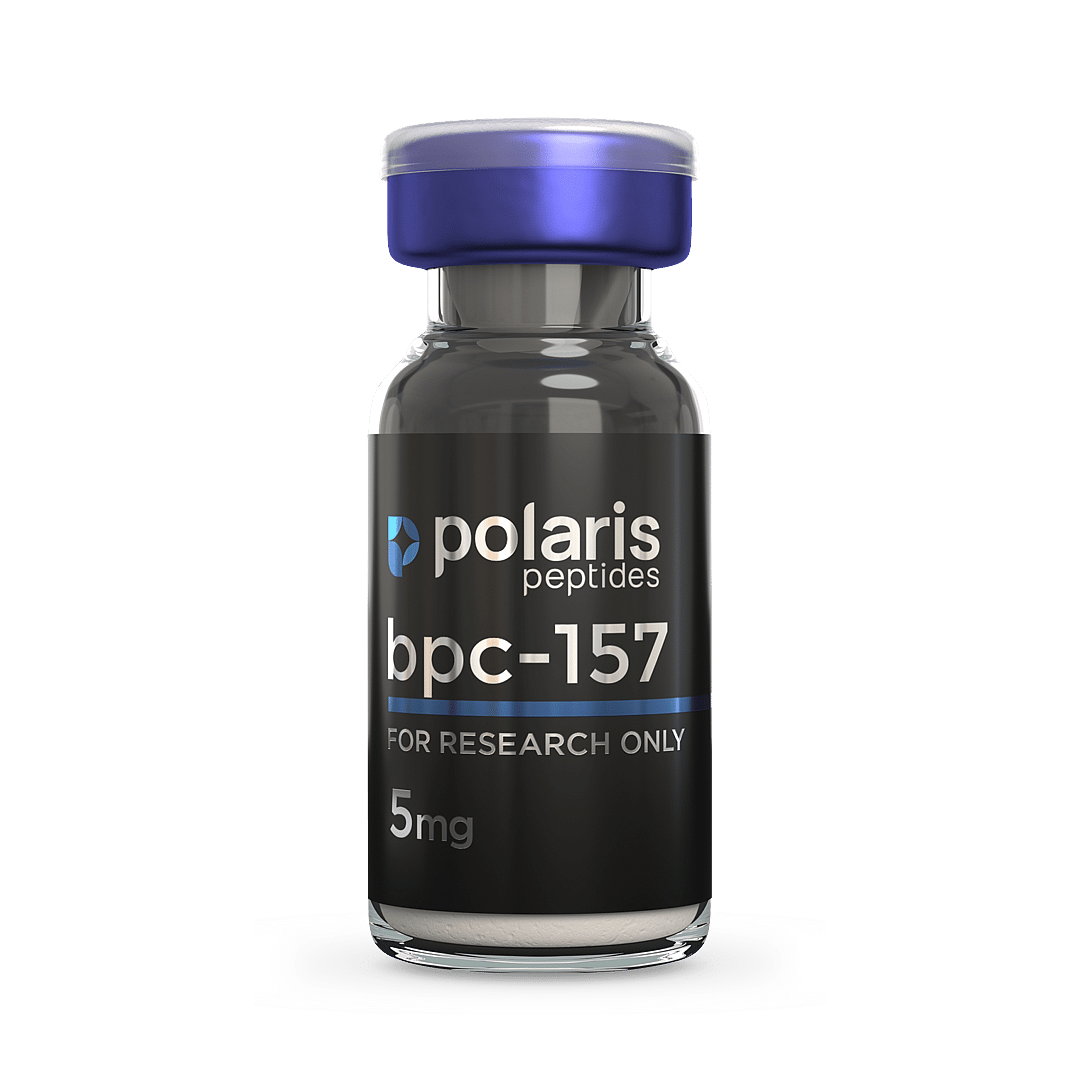
BPC-157 5mg from Polaris Peptides is a lyophilised research peptide with over 99% purity confirmed by HPLC-MS. BPC-157 is a synthetic pentadecapeptide (also known as Body Protection Compound-157, PL 14736), supplied vacuum-sealed and sold strictly for laboratory research.
At $35.00 this vial works out to $7.00 per milligram. It is the smallest size we stock, which makes it a good fit for pilot experiments, method development or a first look at the compound.
What Is BPC-157 5mg?
BPC-157 is a 15-amino-acid peptide (sequence GEPPPGKPADDAGLV) derived from a protective protein found in gastric juice. It is unusually stable for a peptide: it holds up in acidic conditions and in solution better than most short peptides, which is one reason it has been studied so widely in animal models.
Most of the published BPC-157 literature comes from preclinical work on tissue repair. Researchers have looked at tendon, ligament, muscle, bone and gut healing in rodents, along with effects on blood vessel growth and nitric oxide signalling. Human data remains limited, which is why it is sold strictly for laboratory research.
BPC-157 5mg Specifications
| Product | BPC-157 5mg |
|---|---|
| Compound | BPC-157 |
| Also known as | Body Protection Compound-157, PL 14736 |
| Class | Synthetic pentadecapeptide |
| CAS number | 137525-51-0 |
| Amount | 5mg |
| Form | Lyophilised powder |
| Purity | >99% (HPLC-MS) |
| Packaging | Vacuum-sealed |
| Storage | −20 °C dry; 2–8 °C once reconstituted |
| SKU | PLBPC5 |
BPC-157 Research Areas
Published studies on BPC-157 cover several areas. The list below summarises the main ones so you can see where it fits your work.
- Tendon and ligament repair: fibroblast migration and collagen organisation in injury models.
- Gastrointestinal protection: the compound’s original area of study, including ulcer and colitis models.
- Angiogenesis: VEGF receptor signalling and new blood vessel formation around injured tissue.
- Muscle injury models: recovery after crush and transection injuries in rodents.
- Nitric oxide pathways: interactions with the NO system and vascular tone.
Storing and Handling BPC-157 5mg
Store unopened vials at −20 °C, where the dry powder stays stable for long periods. Before reconstitution, let the vial reach room temperature to stop condensation forming inside. Add bacteriostatic water or another lab-grade solvent slowly down the side of the vial and swirl gently rather than shaking. Once reconstituted, keep it at 2–8 °C and complete your work within 28 days.
Why Order BPC-157 From Polaris Peptides
Every batch of BPC-157 we sell is checked by HPLC-MS for identity and purity before it is listed. Vials are vacuum-sealed to keep moisture out and labelled with the exact amount. If you are comparing suppliers, ask for the batch analysis and check it against the label. That is the standard we hold ourselves to.
How BPC-157 5mg Is Tested
We use two methods together. High-performance liquid chromatography (HPLC) separates the contents of a sample so we can see how much of it is the target compound and how much is anything else, such as truncated sequences or leftover synthesis reagents. Mass spectrometry (MS) then weighs the molecules, which confirms that the main peak really is BPC-157 and not a look-alike. A result above 99% on both counts is what earns a batch a place in our catalogue. Lots that fall short are not sold.
Related Research Peptides
BPC-157 is also available in other sizes: BPC-157 10mg.
Researchers working with BPC-157 5mg often look at TB-500 10mg, TB-500 10mg / BPC-157 10mg Blend, GLOW 50: GHK-cu 35mg, TB-500 10mg, BPC-157 5mg Blend, KLOW: GHK-cu 50mg, KPV 10mg, TB-500 10mg, BPC-157 10mg Blend. Browse the full Healing & Recovery Peptides collection, or see every compound in the peptide shop.
BPC-157 5mg FAQ
Where does BPC-157 come from?
It is a synthetic fragment of a larger protein isolated from human gastric juice. The 15-amino-acid sequence is made in the lab by solid-phase peptide synthesis.
Why is BPC-157 often paired with TB-500?
The two peptides are studied for tissue repair through different mechanisms. BPC-157 is linked to angiogenesis and growth-factor signalling, while TB-500 is linked to actin regulation and cell migration. We offer them as a ready blend.
What purity is BPC-157 5mg?
Over 99%, confirmed by HPLC-MS on every batch.
How should BPC-157 be stored?
Dry powder at −20 °C. After reconstitution, 2–8 °C, used within 28 days.
Is BPC-157 5mg for human use?
No. It is sold for laboratory and in-vitro research only. It is not a drug, food or cosmetic and is not for human or veterinary use.
References
Read the published research on BPC-157 at PubMed (U.S. National Library of Medicine).
For laboratory research use only. Not for human or veterinary use. Not intended to diagnose, treat, cure or prevent any disease. These statements have not been evaluated by the FDA.


Reviews
There are no reviews yet.